A Day Trip to Kusatsu Turns on the Afternoon Show and Your Train Home
There are no performances at midday — work backwards from your arrival

The first thing to settle for a day trip to Kusatsu is not where to go but which service you are taking home. The journey is long each way and the time you actually have on the ground is shorter than it looks. On top of that, the yumomi performances are split between morning and afternoon, with nothing at midday. Here is how to work out your hours and how to spend them if you have about 4 on the ground. The figures below are the current ones each operator publishes, but timetables and prices change, so check the official pages before you go.
On this page
First, work out how long you actually have
From Ueno, the Kusatsu-Shima limited express takes about 2 hours 33 minutes to Naganohara-Kusatsuguchi, and the JR bus from there to Kusatsu Onsen takes 25 minutes. Add the wait for the connection and roughly 3 hours each way is a fair estimate. That is not from your hotel in Tokyo, so add the trip to Ueno as well.Getting there by train
The bus from Naganohara-Kusatsuguchi cannot be reserved; you board in the order you queue. Buses fill up and roads run late, so do not plan to reach the station moments before your train leaves.
There is only one thing to do here. Write down the time you reach the Kusatsu Onsen bus terminal and the departure time of the service you intend to take home. The gap between them is your whole day.getting to Kusatsu
There is no yumomi performance at midday
The yumomi and dance at Netsunoyu runs 6 times a day: 3 in the morning and 3 in the afternoon, which in the normal season means 9:30, 10:00 and 10:30, then 15:30, 16:00 and 16:30. In winter the morning performances start later.Yumomi show information
So on a day trip that puts you in town around midday, you miss the morning performances and the afternoon ones compete with your journey home. Admission is 700 yen for adults and 350 yen for elementary school children. It cannot be reserved; tickets go on sale at the window 30 minutes before each performance, and payment is cash or PayPay only.
This is the fork in the road. Watch a performance and take a later service home, or take an early one home and leave the yumomi for another visit, giving the time to a bath and the streets instead. Cram both in and you will rush both.
With about 4 hours, spend them like this
What follows is a guide for having roughly 4 hours in Kusatsu. It is not a timetable, and it guarantees no particular train and bus connection.
Give the first 30 minutes to walking to the Yubatake and once around it. The next hour to lunch. The 30 minutes after that to the streets. The next hour to one bath, including changing and sitting down afterwards. The last hour to picking out something to take home and getting back to the bus terminal to queue.
That hour for the bath does not mean an hour in the water. It covers the desk, changing, and cooling off afterwards. If you wait at the restaurant or at the entrance, trim the walk or the shopping to make it up.
Pick one bath and stop there
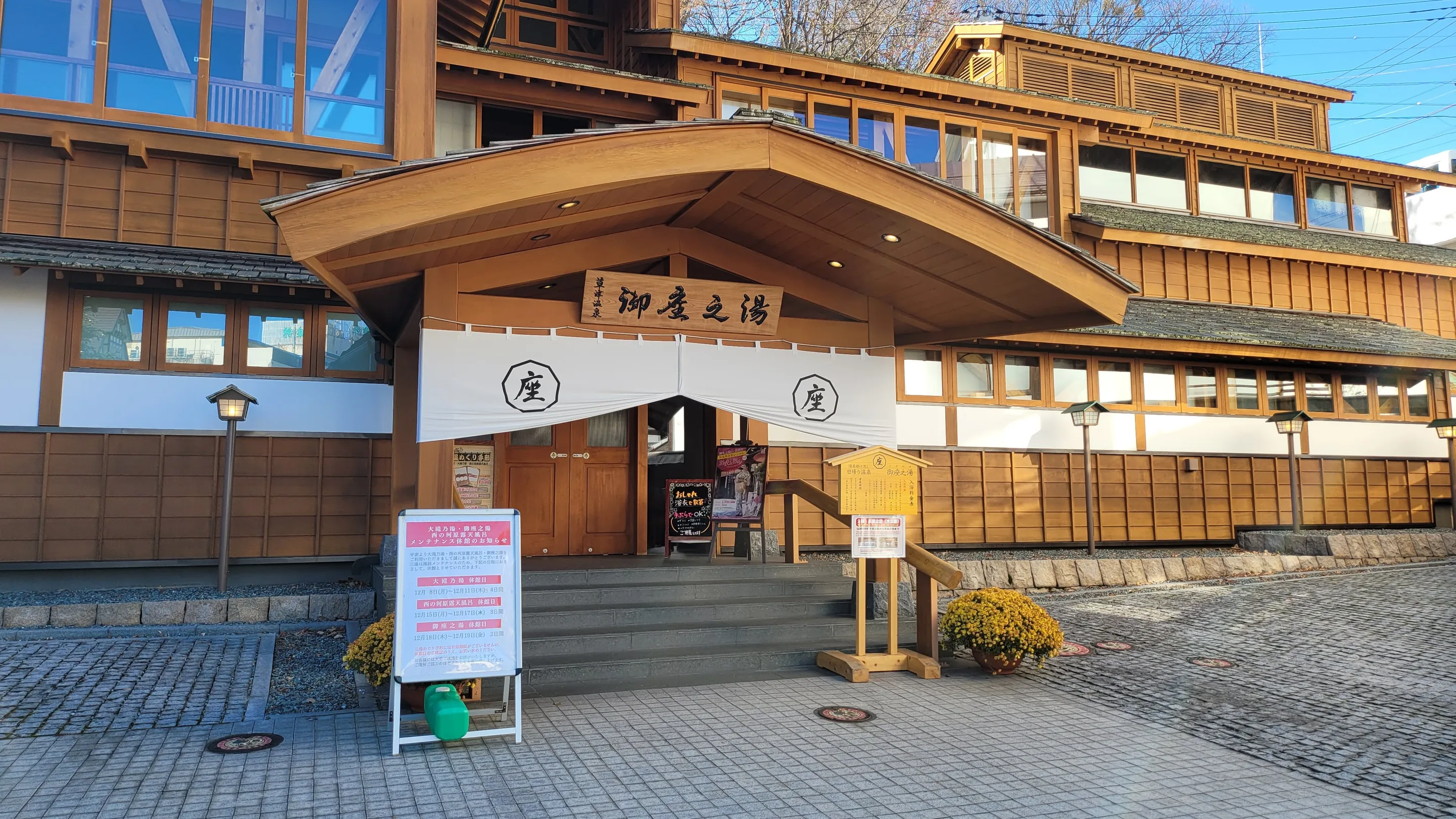
On a day when you want to keep the walking down, Gozanoyu is right by the Yubatake. 900 yen for adults, 450 yen for children.Gozanoyu visitor information
On a day when you want the walk out to Sainokawara Park, put the Sainokawara open-air bath at the end of it. 800 yen for adults, 400 yen for children. Be aware it is an open-air bath and nothing else — no washing stations, no hairdryers, no rental towels — so it does not suit a day when you want to wash your hair before heading home.Sainokawara visitor information
You do not need to plan on two. That is two rounds of changing, and the time comes out of walking the town. For the differences in facilities and hours, see how to choose among the three baths.
Get ready to leave before you add one more stop
Fix the time you will be back at the bus terminal, and only then decide whether there is room for one more stop. Do it the other way round and the length of the queue decides your day for you.
If you want the Yubatake after dark or a walk the next morning, staying the night is the other way to do it. A day trip means choosing fewer places; a night means splitting them between evening and morning. Match it to the hours you actually have.
Can I do Kusatsu as a day trip from Tokyo? +
Yes, but it is roughly 3 hours each way. The limited express from Ueno to Naganohara-Kusatsuguchi takes about 2 hours 33 minutes, and the bus from there takes 25 minutes. How long you get on the ground depends on the services, so write down your arrival and departure times before you plan anything else.
Can I fit in both the yumomi and a bath? +
It depends on your train home. There are 3 performances in the morning and 3 in the afternoon, and none at midday. Taking an afternoon one — 15:30, 16:00 or 16:30 in the normal season — means a late journey back. On an early service home, you will be choosing one or the other.
How many baths can I visit? +
On a day trip, make it one. Each extra bath is another round of changing, and the time comes out of walking the town. Gozanoyu (900 yen for adults) is by the Yubatake; the Sainokawara open-air bath (800 yen for adults) pairs with the walk out to the park.
Can I reserve the bus? +
No. The bus from Naganohara-Kusatsuguchi takes passengers in the order they queue. Buses fill up and roads run late, so do not plan to reach the station moments before your train home.