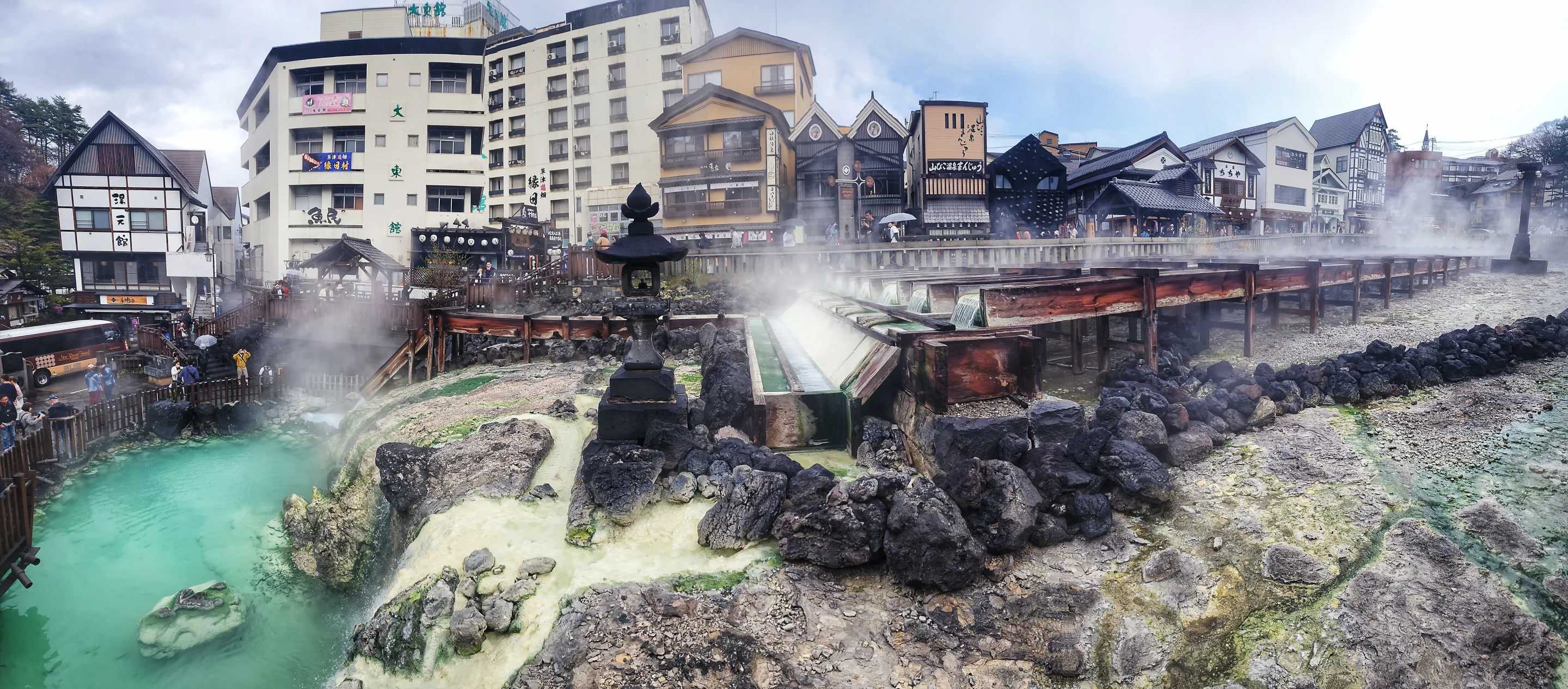
Kusatsu: Walk the Yubatake, Then Soak Once
Three public baths — pick the one with what you want, not all three
.jpg)
Start at the Yubatake, soak once somewhere that appeals to you, and stop for a steamed bun along the way. That is a full day in Kusatsu. There is no need to visit all three public baths. What matters is which one has the facilities you actually want. The prices and times below are the current figures each facility publishes, but cleaning days and seasons change them, so check the official pages before you go.
On this page
Start with one loop of the Yubatake
Watch the water running through the wooden troughs and the steam rising, from the walkway around it. The Yubatake is something you look at, not a bath you can get into. Walking one loop first is what tells you which side street to head down next.
If you are staying the night, come back after dark. Steam under the lights is a different thing from steam in daylight. That said, do not assume early morning or late evening means an empty square. Watch where people are walking, and take photos from a spot where you can stand still.Town map and visitor information
At Netsunoyu, watch the yumomi or do it yourself
At Netsunoyu, beside the Yubatake, you can watch yumomi — stirring the hot water with long wooden boards — performed with singing and dancing. Admission is 700 yen for adults and 350 yen for elementary school children. There are 6 performances a day, 3 in the morning and 3 in the afternoon, and the start times shift in winter.Yumomi show information
Reservations are not accepted. Tickets go on sale at the window 30 minutes before each performance. Payment is cash or PayPay only; credit cards are not accepted. Decide which performance you want first, then put your walk and your meal either side of it, and the day holds together.
If you want to handle a board yourself, the hands-on session is separate: Sundays and Mondays, 11:30 to 13:00, last entry 12:50, 300 yen for elementary school age and up. That one cannot be reserved either. A show ticket does not include it, so go on a day of the week that works.Yumomi hands-on session
Choose among the three baths by what they have
If you want to bathe right by the Yubatake, that is Gozanoyu. 900 yen for adults, 450 yen for children. Open 7:00 to 21:00 from April 1 to November 30, and 8:00 to 21:00 from December 1 to March 31, with last entry at 20:30. The large tatami room where you can sit afterwards, Yugennoma, closes at 20:00 and opens at 9:00, so go in early if you want to linger.Gozanoyu visitor information
If you want a choice of tubs, that is Otakinoyu. 1,200 yen for adults, 600 yen for children, 9:00 to 21:00 with last entry at 20:00. Its awaseyu baths get hotter tub by tub from the first one, so you start in the cooler water and let your body adjust. The restaurant inside closes earlier than the baths — 11:00 to 16:00 on weekdays, 11:00 to 19:30 on weekends and holidays — so eat first if you plan to eat there.Otakinoyu visitor information
If you want the view, that is the Sainokawara open-air bath. 800 yen for adults, 400 yen for children. Open 7:00 to 20:00 from April 1 to November 30, and 9:00 to 20:00 from December 1 to March 31, with last entry at 19:30.Sainokawara visitor information
Be aware that Sainokawara is an open-air bath and nothing else: no washing stations, no hairdryers, no rental towels. Towels are sold for 380 yen. If you want to wash your hair before heading out, Gozanoyu or Otakinoyu suits you better.Facilities and towel FAQ
Treat Sainokawara Park and the bath as two decisions
Walking west from the Yubatake takes you through the souvenir street and out into Sainokawara Park, where hot water runs down the riverbed. The walk is worth it on its own, and whether you go into the paid open-air bath at the far end is a separate call. On a day when someone with you is not bathing, this is the easy way to plan it.
If the bath is part of the plan, check the day of the week. On the second Wednesday of each month it closes at 17:00 for tub cleaning, with last entry at 16:30. Some months keep normal hours instead, so if you are heading over in the late afternoon, read the notices first.Notices on changed hours
Leave slack for a meal and the bus home
Pick one steamed bun, sit down with a cup of tea. That leaves more of Kusatsu with you than working through a list of shops. If dinner is at your inn, check what time it starts; if you are eating out, check closing days and last orders before you go.
On a day trip, build the day around the Yubatake, the yumomi, and one soak, then head for the bus. Staying over, do not cram the afternoon — split the walking between the evening and the next morning. This is a rough shape, not a timetable with crowds and waiting built in. For the trip out from Tokyo, see getting to Kusatsu.
Is it worth coming if I do not want to bathe? +
Yes. A loop of the Yubatake, the show at Netsunoyu, the walk through Sainokawara Park, the souvenir street. If someone with you is not bathing, walk as far as the park together and let whoever wants a bath go separately.
Should I try all three public baths? +
There is no need. The adult admissions add up to 2,900 yen, and that is three rounds of changing clothes. Gozanoyu for being next to the Yubatake, Otakinoyu for the variety of tubs, Sainokawara for the view. Picking the one that has what you want makes for a calmer day.
Can I wash my body and hair at Sainokawara? +
No. There are no washing stations and no hairdryers, and no rental towels either. Towels are sold for 380 yen. If you want to wash your hair, choose Gozanoyu or Otakinoyu.
Can I bathe if I have tattoos? +
The three baths — Gozanoyu, Otakinoyu and Sainokawara — state in their official FAQ that they do not specifically refuse entry or bathing to people with tattoos. Other inns and bathhouses set their own policies, so check individually.