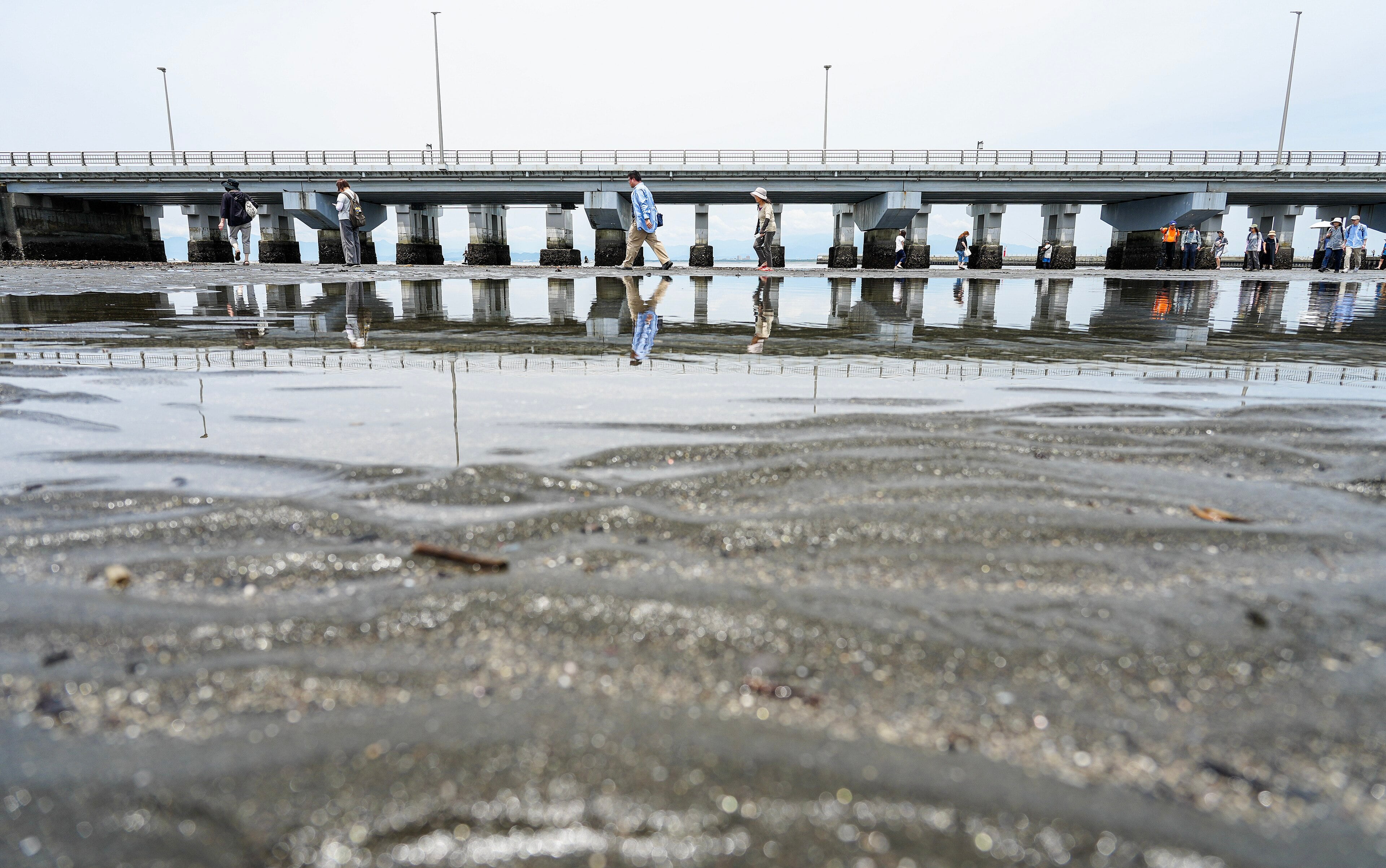
Enoshima, cross the bridge and climb
Three stations, and an island of staircases

Enoshima sits about an hour from Shinjuku on the Odakyu Enoshima Line. It is called an island, but a bridge connects it to the mainland, so you walk across. The shape of the day is simple: cross, climb, come down, look at the sea, go home. Only three things are worth deciding in advance — which station you get off at, which ticket you buy, and how far down the island you go. The fares and hours below are the current published figures, but prices change and facilities close without much notice, so check the official pages before you set out.
On this page
- Three stations serve the island, and the one you pick changes your walk and your way home
- The ticket question comes down to whether you will ride the Enoden
- The island is a staircase, and the Escar only goes up
- Whether you go down to the Iwaya caves is what separates a half day from a full one
- If you are staying for the evening, learn the order in which things shut
Three stations serve the island, and the one you pick changes your walk and your way home
Three different stations will get you to Enoshima: Katase-Enoshima on the Odakyu line, Enoshima on the Enoden, and Shonan-Enoshima on the Shonan Monorail. The names are nearly identical; the stations are not. Fujisawa's tourism guidance puts all three at a 15–23 minute walk from Enoshima Shrine, so whichever you choose, you are walking.
From Shinjuku, Katase-Enoshima is the straightforward entry. The fare is ¥650 one way, or ¥649 with an IC card. If you take the Romancecar limited express, the surcharge is a separate ¥750 (¥700 if bought ticketless). Journey time depends on which service you board, so check the official timetable for the day you travel.
The walking starts at the station. Enoshima Shrine's own guide allows about 15–20 minutes from Katase-Enoshima station to the far end of Enoshima Benten Bridge. The bridge runs 389 m, and you are over water the whole way.
If you want to come back through Kamakura, use the Enoden's Enoshima station; for Ofuna, use Shonan-Enoshima on the monorail. The monorail covers Ofuna to Shonan-Enoshima in 14 minutes for ¥340 adult and ¥170 child (revised 14 March 2026). Arriving at one station and leaving from another saves you retracing the same road.
The ticket question comes down to whether you will ride the Enoden
Two one-way fares from Shinjuku come to ¥1,300. Odakyu's Enoshima-Kamakura Free Pass costs ¥1,640 for adults and ¥430 for children from Shinjuku and is valid for one day. It covers a round trip from your departure station to Fujisawa, plus unlimited rides on the Odakyu line between Fujisawa and Katase-Enoshima and on the whole Enoden line. The leg between your departure station and Fujisawa may be used once in each direction.
So the gap is ¥340. A useful yardstick is the Enoden's own one-day pass, Noriorikun, at ¥800 for adults and ¥400 for children. If ¥340 buys you the entire Enoden for the day, the free pass makes sense on any day you plan to continue to Kamakura or Koshigoe. If you are only seeing Enoshima and returning to Shinjuku, two single fares cost less.
The Romancecar surcharge is charged separately even if you hold the free pass.
The island is a staircase, and the Escar only goes up
Enoshima is a small mountain. Steps run from the approach road to the summit, and you will be out of breath before the top. There is a paid outdoor escalator, the Escar: by the shrine's reckoning, section 1 runs from the vermilion torii to Hetsumiya, section 2 from Hetsumiya to Nakatsumiya, and section 3 from Nakatsumiya to the summit. All three sections cost ¥500 for adults and ¥250 for children, and lift you 46 m in about four minutes. It runs 8:50 to 19:05.
The part that matters: it goes up only. There is no Escar down. You walk the steps on the way back. If your knees are a question mark, the sensible use is to let the machine take the climb and save your legs for the descent.
The official estimates for walking are published too. From the vermilion torii up the stone steps to Hetsumiya is about 3–5 minutes, Hetsumiya to Nakatsumiya about 5 minutes, and Nakatsumiya to Okutsumiya about 10 minutes. The island's three shrines — Hetsumiya, Nakatsumiya and Okutsumiya — sit in that order from the bottom up.
In the Hetsumiya precinct stands the octagonal Hoanden hall. Viewing hours are 8:30 to 16:30, and admission is ¥200 for adults, ¥100 for junior and senior high school students and ¥50 for elementary school children, free below school age.
Whether you go down to the Iwaya caves is what separates a half day from a full one
On the far side of the island are the Iwaya sea caves, about 10 minutes on foot from Okutsumiya, down a flight of steps. Admission is ¥500 for anyone of junior high school age and above and ¥200 for elementary school children, open 9:00 to 17:00 with seasonal variation.
Add up the official segment estimates from the station to Iwaya and the walking alone comes to roughly 45–55 minutes one way. Put the return leg and the time inside the caves on top of that, and Iwaya becomes the centre of gravity of your day. Leave it out and the trip folds neatly into a half day: cross the bridge, see the shrine, eat on the approach road, come back. Deciding which of the two you are doing before you leave keeps you from racing the clock on the island.
Iwaya closes when the sea is rough. On days with high waves or bad weather, check the day's status with the Fujisawa Tourist Centre (0466-22-4141) or the official page before you build it into the plan.
If you are staying for the evening, learn the order in which things shut
Enoshima closes in stages as the afternoon goes. The Hoanden at 16:30, Iwaya at 17:00. The Samuel Cocking Garden is free from 9:00 to 17:00; after 17:00 it costs ¥500 for adults and ¥250 for children. The Escar stops at 19:05.
The garden itself stays open until 20:00, with last admission at 19:30, thirty minutes before closing. The Enoshima Sea Candle is ¥800 for adults and ¥400 for children. If you want it bundled, the Enoshima 1day ticket is ¥1,550 for adults and ¥700 for children and combines the Escar, the garden and the Sea Candle. These are the prices as revised in October 2025.
Lay that out in order and the pattern is clear: most of what you came to see closes before evening, and what remains after dark is the lit summit. If you have decided to stay for the sunset, do Iwaya and the Hoanden while it is still daylight. Check your train home before you commit to staying, not after.
Hours are sometimes extended during event periods.
How much time does Enoshima need? +
Cross the bridge, see the shrine, eat on the approach road and head back, and it is a half day. Go down to the Iwaya caves and it becomes a full one. The walk from the station to Iwaya is roughly 45–55 minutes one way by the official estimates, and the island is made of steps, so it takes longer than the map suggests.
Which station should I use? +
Coming from Shinjuku on the Odakyu line, Katase-Enoshima is closest to the bridge and the easiest way in. If you are continuing to Kamakura afterwards, use the Enoden's Enoshima station; for Ofuna, Shonan-Enoshima on the monorail. All three are a 15–23 minute walk from Enoshima Shrine.
Is the free pass worth buying? +
The Enoshima-Kamakura Free Pass from Shinjuku is ¥1,640 for adults and ¥430 for children, valid one day. Against ¥1,300 for two ¥650 singles, the gap is ¥340, and it adds unlimited travel on the whole Enoden line. Worth it on a day you ride the Enoden; not worth it if you are only seeing Enoshima and going home.
Can I get around without the stairs? +
The Escar runs up only, ¥500 for adults and ¥250 for children across all three sections. There is no Escar going down, so the return is on foot. Routes that avoid steps are limited on the island, so assume you cannot avoid them entirely.